Saturday, 4 November 2017

TRAVEL: Costa Rica - snakes, storms and not a single sloth

There are many reasons to visit Costa Rica, perhaps most prominently its vast array of indigenous wildlife - sloths, frogs, snakes, insects. This was a key reason why it's been on my bucket list for a while now. I was also interested in visiting the country due to its sustainability credentials, being one of, if not the most, green country (in both senses of the word) in the world. 

Most visitors will arrive into San Jose airport, an airport which isn't actually in the district of San Jose but was moved outside over 40 years ago. This means that you have to drive from the airport along the inter-American highway, US 1, which I believe takes you from the United States all the way through Central America. There's a road trip plan if you need one! 

Our hotel for our first night in Costa Rica was just outside of San Jose, called The Bougainvillea which, due to its name, had lovely vibrant bougainvillea growing outside. The hotel was very pleasant and has an absolutely massive garden of its own of about 10 acres. We were tempted to explore it, but the weather had other plans. Being in the tropics, Costa Rica is no stranger to tropical storms, but thankfully here they're fairly predictable, occurring every day during the rainy season at about 2pm. Sure enough, at 1:45, the heavens opened - one second no rain, and then BAM, here comes the flood alert. It was quite a spectacle. The lights in the room began to flicker until suddenly they all went out. I stepped outside into the hallway to see they had the emergency lights on - quite an eerie experience. 
However, true to form, the shower was short and sharp and cleared up soon enough. Due to its location, there wasn't much to do outside of the hotel, so we spent the afternoon there and ate in the hotel's restaurant. I went for 'casado', a Costa Rican dish of rice, beans, vegetables, potatoes, fried plantain, a tortilla, and your choice of meat and fish. Very filling but a nice array of flavours to get your teeth into. 

The next morning we were to leave the hotel at the ungodly hour of 6am, but I'd already been woken by one of CR's delightful tropical birds singing outside my window as soon as dawn broke. We were collected in a minivan to head to our next destination, Tortuguerro. As the drive is a good few hours, we stopped midway for breakfast at the Suerre hotel in Guiapiles. The selection was similar to yesterday's dinner - like Mexico, beans and rice are some of CR's staple foods. 
Along the way, we got a glimpse of life in CR, much of which is based around tourism or agriculture. This meant lots of coffee and pineapple plantations, and most interestingly, banana plantations - this is where your Chiquita and Dole bananas come from. It's a proper system here - workers must find and cut bananas at just the right time so they'll ripen when they arrive in our stores, and cover a huge amount of ground, dragging the bananas back to the cleaning station along long wires.
On we went until we reached the main river point to Tortuguerro, where we transferred to a small boat which took us about an hour and twenty minutes to get to the Manatus Lodge, apparently the only lodge in the Tortuguerro area with air conditioning and TV's! Manatus refers to the scientific name for manatees who do still roam these rivers, although spotting one is very rare. The rooms are large with beautiful designs on the sinks and ceramics - parrots, frogs and butterflies. We're also right in the middle of the rainforest here - I just had to stop blogging to take photos of some spider monkeys eating in the tree outside my room! 
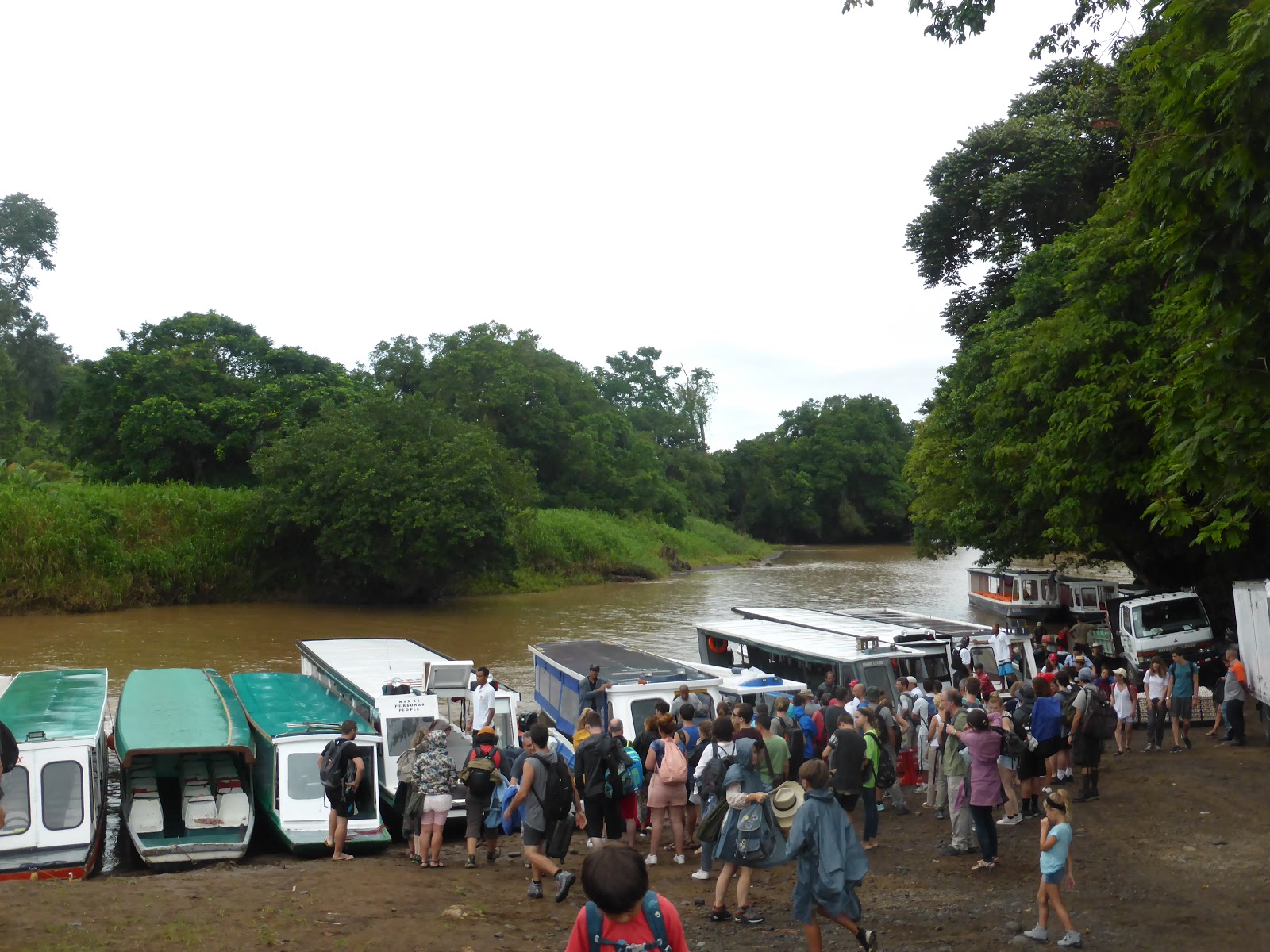
After our 3-course a la carte lunch (Manatus is full board - not good for your waistband if you spent too much time here!) we were back on the boat for a quick trip to the main village of Tortuguerro. Walking just 20 metres from the river side of the village to the other side and you reach the Caribbean Sea - my first glimpse of this Sea. Whilst lovely and warm, the waves were quite something - two kayakers trying to make their way beyond the breakers were having a very hard time! 

Tortuguerro is a souvenir paradise and almost every shop is a souvenir shop. Every other is a restaurant. CR thrives on tourism and they had some lovely crafts - all the wildlife in whatever form you wanted them - soft toy, magnet, wooden carving, jewellery. A pleasant place to spent the hour. 
We had a late night that evening having signed up to see Costa Rica's famous sea turtles. However, visiting the protected section of the beach that they nest in is done by a lottery, with possible slots for our hotel being between 8-10pm and 10-12pm. We got the later slot! At 9:30, we caught the boat across the river to Sector 2 (out of 6) where visitors are allowed to see the turtles, with the rest of the beach area reserved solely for the turtles. Unfortunately (but understandably) cameras are not allowed so I have no photos for you, so I've interspersed this section with extra wildlife photos instead!
We were met in darkness by one of the National Park rangers who brought us to see one of the turtles, a green turtle. The turtle was much bigger than I'd imagined, only slightly smaller than a giant tortoise so she'd created a large hole in the ground to accommodate her body. The aim in Tortuguerro is to disrupt the turtles as little as possible, so visitors are not allowed to see the first two stages of their nesting - when they arrive and make their way up the beach, and when they dig a hole in which to lay their eggs. However, we managed to see the following 4 stages: 

1. Laying eggs: We got there just in time to see the turtle laying her eggs, which basically involved dropping eggs two at a time into the hole she'd dug. On average, turtles will lay over 100 eggs at a time and lay eggs 2-3 times over the 4 month nesting period. Shortly after we'd arrived, she finished laying her eggs, and began the next stage. 
 
2. Covering: Using her powerful back flippers, she began flicking sand backwards into the whole to cover up the turtles. Whilst tiny when born, the baby turtles will still be able to break through all of this sand as she leaves it loose and not tightly packed.
 
3. Camouflage: Then it was time to use her front flippers to flick more sand all over the place to cover the hole she'd dug as much as possible to make it more difficult for predators to find. To give you an idea of the power of her flippers, we were occasionally hit by rogue flying sand standing metres behind her, sometimes even in the face! It's amazing the amount of energy these turtles have, particularly after having just laid 100 eggs.

4. Return to the sea: After spending an hour of so covering and camoflaging, the turtle is ready to return to the sea. She turns herself around in the whole and then drags herself back to the shore (flippers work much better in water, so this is tough work) until she's carried away by the sea. 
During our time at the beach, we saw 3 turtles nesting, and one who came onto the beach before deciding it wasn't the right place for her and turning around, leaving a fascinating u-turn shape in the sand. Admittedly, I had thought we would be seeing the hatched baby turtles making their way back to the sea, but had come at the wrong time as hatching season is between October and November - keep that in mind if you'd like to visit CR to see them. Right, back to relevant photos.

My tiredness wasn't helped by the early start the following morning for our morning boat trip. We saw a few snake birds (so called because they don't have the water-resistant oil in their feathers that a lot of diving birds do, meaning that once they surface their body doesn't float, leaving only the neck and head sticking out of the water like a snake), iguanas, a caiman and a particular highlight for me, the wonderfully named Jesus Christ Lizard, so called because it can run on water! 
We had another trip that afternoon including more iguanas, toucans (including the fantastic Kill Bill toucan because of its vibrant yellow colouring), tiny adorable bats, herons, and apparently a sloth, though you wouldn't know it. Far away towards the back of a tree was a grey mass, which using maximum zoom on my camera I could make out arms and legs. I was hopeful that we'd get a better view of some sloths in the following days! 
We had another excursion planned for that night - a night walk to look for more nocturnal animals. I was a bit annoyed that this activity wasn't included in the cost of the hotel stay as the boat trips were, and cost us an additional $30 per person in spite of the fact that I'm sure most guests would be interested in doing the night walk. The turtle excursion had also been an extra charge, but this is because it is run by the National Park folk, which makes the fee a bit more understandable. 
The walk was a success to a certain extent in that we saw a number of frogs, including the green tree frog which has become the symbol of Costa Rica's ecological endeavours and the 'blue jeans frog' so called as it is red with blue legs; a number of scary looking spiders you wouldn't want to find in your bed; and a variety of insects, mostly grasshopper types. We also saw, way up in the trees, three raccoons - still cute even when you can only just see them. I was also pretty impressed with my own tracking ability in spotting a number of frogs and insects even the guide didn't see - if this whole blogging thing doesn't work out, maybe there's a job for me there? However, I do think our group of 9 was too large to have a fully enjoyable experience - but hey, if you're getting $30 a piece it's not like you'll turn people away! 
Another early morning the following day (lie-ins don't seem to exist on wildlife holidays) as we were catching a flight from one of the world's presumably smallest airports and perhaps least equipped - the airport building contained nothing but two toilets, sans doors, and one sans toilet. However, that may have been better than the other which was covered in about 30 years of moss. Needless to say, none of us felt the urge to use it. Check in was also done at a foldable table outside the building without a computer in sight. We then boarded a 12 seater propeller plane to much bigger than a Cessna. I liked the feel of it - almost like a private jet but, you know, without the beds, waiting staff, TV's etc etc. 
30 minutes later and some wonderful views of a nearby volcano as these planes can fly at a much lower altitude than commercial planes, and we arrived in San Jose airport again. We collected our bags from the marginally more equipped small airplanes section of the airport and met a driver to take us to our next destination, 3 hours away by car. En route, we stopped at a pleasant restaurant come cafe 'Macadamia y cafe' where everything is handmade, a welcome stop in the long journey. 

The landscape began to change as we made our way upwards in altitude until eventually we rose above the clouds. We'd made it to Monteverde - the cloud forest with the apt name translated as 'green mountain'. After checking in at our hotel, the Hotel Belmar, a large lodge/chalet complex with pleasant views (well, they would be if the sky ever cleared) we headed in to the nearest town, although there wasn't much there aside from a variety of overpriced souvenir shops. Speaking of, most things in Costa Rica seem overly expensive, so bear this in mind. However, having a captive audience allows them to do just that. 

We had lunch at Cafe Orchid which was nice - my meal included retried bean and cheese empanadas, pumpkin soup, grilled cheese and garlic sandwich, and a delicious homemade pineapple and orange smoothie. I would absolutely recommend. On the way back, I managed to pick up some more dogs who began to follow us around, something which seems to have become a bit of a habit of mine. We did try to shoo them off (these roads are no place for dogs to be running around!) but thinking it was a game, they just became more attached. I can't say I minded the company though.

Added benefits of the Belmar include it's private nature trail, which takes about 25 minutes to walk through and was very enjoyable particularly as there's no one else around; a large pond from which you can watch the hummingbirds buzzing around the tropical plants (and attempt/fail to take photos as they move too fast) and complementary yoga twice a day which I tried and am still aching from. 
Another early start for our main adventure in Costa Rica - a guided wildlife tour around Monteverde Cloud Forest Reserve. Unlike many places of natural beauty, Monteverde is not a National Park, but a series of private reserves so it's up to you which section of the forest you'd like to visit. We were collected at 7am by our guide Oscar, who looks more like Tom Hanks than Tom Hanks does. To be honest, that fact was more interesting than most of the tour. He spoke as if presenting a nature documentary: "Sometimes...in the forest...we hear sounds...If I hear this...'ch ch ch ch'...I know it is a bird...There are many trees here...all of which...hold secrets..." Nonetheless, he knew his stuff. 
Unfortunately, we seem to be pretty unlucky with wildlife lately and in our four hour trek, only saw the back of an agouti (a large guinea pig type creature), a couple of birds, a dead wasp (interesting apparently because it had been paralysed by a parasitic fungus) and many hummingbirds, most of whom we found in the artificial environment of sugar feeder stations. But, as they say, nature is as nature does. What we hadn't been aware of is that sloths, the animal we were most keen to see, are very rare around these parts and are only spotted 2 times a month maximum. So there you have it folks, you can spend a week in Costa Rica without seeing a single (complete) sloth! 
As the tour was shorter than we'd anticipated, we needed something to occupy ourselves for the afternoon. Having visited the town the previous day, this left pretty much only the adventure park where you can zipline etc, a frog terrarium, visiting some of the other reserves but probably seeing nothing without a guide, or going on a tour of the Don Juan coffee plantation. We chose the latter and were collected by representatives from the plantation who drove us to the other side of town. In fact, we ended up getting a better view of an agouti from outside one of the hotels than we'd had in the reserve...

The tour was a good way to pass the afternoon, although expensive as has come to be the norm in Costa Rica. 60% was dedicated to the coffee plantations, and we were shown how they grow from bean to plant, how they are harvested and dried, and how the beans are extracted and roasted. Whilst not a coffee drinker myself, I did learn new things about coffee, for instance that the darker and more bitter the coffee, the less caffeine it contains, although most consumers probably think differently; and that Finland is the largest coffee consuming country in the world.
The next 10% was dedicated to sugar cane where we had the opportunity to juice some sugar cane and try some sugar water, first plain (as you'd expect sugar water to taste) and then with a special Costa Rican citrus (like flat Sprite). Tasting is always the best bit of any food-related tour (for further proof - check out my Mexico travel blog!)
They saved the best til last - chocolate. We were brought into a room where we were told how a cacao pod becomes chocolate, and given the opportunity to taste the beans straight out of the pod where they are covered in a fruity pulp, crushed cocoa nibs, a lovely paste of cocoa, vanilla, sugar, cinnamon, salt and pepper, and finally as the finished product - dark and white varieties and milk chocolate covered coffee beans. The tour finished with coffee tasting (in the gift shop of course) and we were then sent home, full to the brim. 
Our final activity in CR was a last night walk. As it was organised through the hotel, we were able to go to a private reserve that only the hotel uses, meaning it was just us and 2 or 3 other groups which was much nicer than loud voices and torches everywhere. To be honest, our guide wasn't particularly good and only spotted a few sleeping birds and a frog himself. Yours truly actually managed to do better spotting including some scary-looking spiders, more insects than you'd care to find in your room and most spectacularly, a scorpion. This was very cool as we turned off all the torches, shone a UV light, and it flouresced. Very very cool. Thankfully we did run into some of the other groups whose guides pointed out a kinkajou (raccoon-like creature up in the trees) and a snake. Not a mega successful trip but I was pleased to have found so many creatures! The following morning after a quick walk around the hotel to spot a coati, we got back in the car to San Jose, and to home.
Tips for Costa Rica: timing and location is everything. If there are specific animals you want to see, check when and where they're likely to be, and plan your trip around this. Furthermore, plan as much as you can in advance. Whilst it might seem like you can't be bored somewhere as exciting as Costa Rica, in places where there's not much to do aside from visit nature reserves, you'll want to know there are things to fill your time when you're tours are over. Finally, bring dollars as well as the local currency (colones) - CR is expensive so depending on the exchange rate you might do better with one currency over the other. ¡Pura vida!

Thank you for joining me on my round the world trip! Don't worry, that's not all the travelling I'm doing and they'll be more very soon - stay up to date by following me on Twitter @CiarasCountry I'm choosing where to travel to next and I'd love your opinions - leave a comment below!

Monday, 30 October 2017

Concert Review: HARRY STYLES, Eventim Apollo, London


*Scroll down for my photo gallery from the concert!*

I arrive at the Eventim Apollo shortly after doors open for Harry Styles' first UK tour stop, and have never seen such a long queue for a concert as this one - it stretches all the way back to Hammersmith Bridge. It almost looks like the queue holds far more concert-goers than will fit in the venue, and this is after some have already gone in. I take my place and thankfully the queue moves swiftly so it isn't too long before we make our way to the front of the venue. As we snake our way through the metal barriers, I step over more and more discarded duvets, pillows and blankets, making it clear that many fans had been camping here to get front row spots.

Making my way into the venue, I saw how they were managing to fit so many fans inside - the entire stalls section had been converted to standing, and was packed to the gills. I found it amusing how this was marketed as 'an intimate gig' when in fact there were clearly thousands of us here. Always being one to try and avoid getting crushed in pits, I had opted for a seat up in the Circle, which again was very full, even with standing room right at the back. Taking a look around, it was interesting to see that the audience (predominantly female, unsurprisingly) seemed older than the One Direction fans I'd expected - most were school leaver or university age, and very few parental chaperones to be seen - suggesting that Harry's audience had matured along with his sound.

At 8pm, the opening act Muna took to the stage. I'd never heard of them before so had no idea what to expect, and admittedly had a bone of contention to the fact that Harry's opening act in the States was Kacey Musgraves, who remains one of my favourite artists and who I would have loved to see. Muna turned out to be a trio of women who took to the stage in business suits, which worked well with the minimalist set of just two small screens bearing the band name and a crescent moon outline.

They began with a chart-like pop number Loudspeaker, complete with syncronised jumping up and down from the band. The crowd seemed very responsive with a number singing along wholeheartedly to songs like Everything, about being obsessed with someone, and a cover of Stevie Nicks' (whom they described as one of the greatest musicians of all time) Edge of Seventeen. They finished up with a high-tempo dance track I Know A Place which certainly allowed those in the Circle to get their dancing shoes on - although I'm not sure there was much room down below...

I wish I could give you a proper review of the opening act, but the sound quality in the venue was atrocious, at least for the beginning, with the instrumentals completely drowning out any vocals. As a result, I couldn't even catch lyrics to jot down and find out songs later. However, they were interesting to watch and certainly seemed to be feeling themselves with lots of interpretive dancing, and in sync headbanging.

Then for the main event. I had booked my ticket to see Styles before his album was released, having only heard Sign of the Times but expecting big things nonetheless. Admittedly, his new style wouldn't be 100% my cup of tea, but I was sure I was in for an entertaining night nonetheless and I am positive that many in the audience would leave feeling as if they'd had the best night of their lives - what more can you ask for?

After Muna left the stage, the screaming was almost continuous and the excitement clearly palpable. Cheers erupted as a large pink silk screen floated down to cover the stage as the set was changed - this was undoubtedly a case of fandemonium, as evidenced by someone in the pit collapsing just ten minutes before Styles took to the stage, needing to be hauled out and whisked away for medical attention. I couldn't help but feel sorry - no doubt she'd been one of the ones camping outside, only to be taken away minutes before her idol came on stage.

The screams increased in decibels (if possible) as a harmonised 'Tell me something I don't already know' played out of the speakers, closely followed by a silhouette of Styles on stage, which resulted in a collective surge in the pit - again, very glad to have been upstairs in my own seat! The curtain fell and Harry was revealed centre stage, impeccably dressed in a sky blue designer suit. As he began Ever Since New York I couldn't help but be impressed by the crowd screaming every word along with him. I'd wondered at the beginning whether they really loved his music as opposed to just him, but this seemed to answer my question.

The atmosphere certainly made it feel like more of a stadium tour than an intimate gig, and in spite of all of the concerts I've been to, I can honestly say I've rarely, if ever, seen a crowd quite like this one. Harry moved on to sing Two Ghosts, a song which I think was able to highlight the difference between not only now and his pop days, but also between his solo route and those of his ex-bandmates. This is far more glam-rock than pop and an interesting change of direction for someone who could just have easily made a mega-successful bubblegum pop album.

Styles shifts from rocky numbers like Carolina to strong ballad-like songs such as Sweet Creature, bathed in a soft purple light. Like Muna's set, this too is minimalist, and only changes when he requests to 'take it up a notch' to sing Only Angel surrounding by flashing lights in the background. He certainly has stage presence, strutting up and down the stage and dancing a bit now and then, as well as engaging well with the crowd, picking on a few fans in the front to chat to them, which helped me find out that some had been camping out since Tuesday - that's five nights of sleeping on the street to see a concert. I mean, I'll occasionally get to gigs a few hours early if I'm keen to queue, but this is next level. Harry must be proud of his fans dedication.

A lots of the lyrics in his songs are fairly repetitive such as in Woman and allow themselves to be easily sung, even if you don't know them word for word (which I'm sure was not the case for the vast majority). As well as playing most of the songs from his own self-titled album, he also treats us to a song he wrote for another artist in the form of Ariana Grande's Just A Little Bit Of Your Heart, which I didn't know he'd written but was all the more impressed by, and of course some One Direction songs such as Stockholm Syndrome and What Makes You Beautiful, but in a style so different from their original versions that you could be fooled into thinking they were completely new songs.

However, throughout this section, Styles paused a few times as yet more girls have to be hauled out of the pit, dealing with dehydration or trampling I would imagine. Nonetheless, he deals very well with this, stopping the set, asking for the houselights to be brought up and asking everyone to give the injured room until it is sorted. His motto is very much about treating each other with kindness and I was pleased to see that he too practiced what he preached.

The next song was undoubtedly the most well-received - Kiwi, whose lyrics scream "I think she said 'I'm having your baby, it's none of your business!' I wonder if he wrote this song too, and whether it is based on personal experience - definitely a big change of content from his boy band days. I enjoy listening to his distinctive voice, but think he could just have easily told the crowd the name of each song and let them sing the entire song, and have resulted in the same endgame of an entertaining night.

The main set ends here (cue more girls being pulled out of the pit - it's getting worrying) but Styles returns shortly after to sing From the Dining Table, a song with enjoyable lyrics like 'Even my phone misses your call'. He follows this up with a cover of Fleetwood Mac's Break The Chain which is always well covered by artists, and I enjoy seeing how different artists put their own spins on it - from Little Big Town (who Harry has also done a cover of) to Styles himself.

There's little guessing as to what songs he should finish his set off with as the crowd chants 'Kiwi, Kiwi, Kiwi' to which he obliges, in spite of having already played it once. I found this interesting in the fact that so many wanted to hear it again as opposed to a different song - Styles fans, help me out here? The set officially ends with the crowd pleasing Sign of the Times to which all of the phone lights in the audience are lifted up. Harry bows, leaves the stage, comes back to blow more kisses, and leaves again as the band continue with the final chords. The end of the gig is like a collective sigh of thousands of girls telling each other 'wasn't that amazing?'

Ultimately, I feel privileged to have shared that night with such a dedicated fanbase, and to see an artist who is far from the end of his solo journey. Few will have the same influence on a generation, or at least part of it, as Harry Styles will. Watch this space.

Did you enjoy my review of Harry Styles' intimate gig? I'd love to hear your thoughts on Twitter @CiarasCountry, where you can also share your experiences of the concert if you were there too! There's lots more where this came from, so stay tuned for further reviews and interviews from fantastic artists coming soon! 

Gallery


Saturday, 28 October 2017

TRAVEL: Santiago, Chile - walking, winter and warm desserts

August in Santiago, Chile is deepest, darkest winter, and it does feel like it, especially for someone who had spent the last few weeks in countries warmer than her natural habitat. Here, it's like England in December - something I'd hoped I wouldn't have to come into contact with for another few months! 

We were given the chance to warm up at our hotel - French boutique Le Reve, which had certainly gone all out to present itself as French including playing French versions of popular songs in the lounge. Arriving in late, we were in time for the midnight snack, a selection of biscuits, coffee and orange juice served in the hotel's small kitchen. My favourite thing about this hotel were the duvet covers - some of the softest I'd ever slept in. I would've been tempted to buy a set myself had I had space in my hold luggage. A past guest had gotten me excited by writing in the guest book how lovely breakfast was, but they must've had a different selection to us - just standard continental. 

We only had a day in Santiago but planned to make the most of it. In order to do so, we jumped on the Metro (an easy transport system to navigate and cheaper than taxis) to Plaza de Armas, Santiago's main square. It's impressive that some of the historical buildings in this square are still standing given the country's history of large scale earthquakes and fires. Perhaps most impressive is the Cathedral, which at the time we arrived had two masses running consecutively. Clearly this is what Chileans do with their Sunday mornings! 
At 10am, we met up with a free walking tour outside the Cathedral we've found online. Running tours at 10 and 3pm everyday, they're easy enough to spot with their red uniforms. Each timeslot has two tours running in Spanish and English - ours was with 25 year old student Valentina whose passion for sharing the city's history shone through throughout the tour. 

We began in the Plaza seeing the Cathedral, City Hall, and Post Office - all impressive buildings dating back to the colonial period (barring redevelopment following fires and earthquakes). This was followed by more impressive buildings in the form of the Pre-Columbine Art Museum - free to visitors on the first Sunday of each month - and the Old Congress Building. 

The most interesting building, and the only one I remember from previous trips to Santiago, was the Palacio La Moneda, the huge white presidential palace. The walking tour planned their timing well as we arrived just before 11am when they undertake the changing of the guards. This is nothing like the changing of the guards at Buckingham Palace or Horseguards Parade but much more of a ceremony, and for that reason there were hundreds of people crowded around outside by the time we arrived. Shortly after, a fanfare began from down the road, and soldiers on horseback and on foot, accompanied by a military band progressed up the road and into the space in front of the Palacio. Lots of military calls later, some more music, and some strange horse-patting later and the guards were changed. A pretty cool event. 
We continued past the Stock Exchange, New York Street where Santiago's first skyscraper was built, and the Opera House, which had undergone a fire, earthquake, fire, earthquake and fire since it opened if I'm not mistaken. Valentina said now the population was just waiting for another earthquake to come along to change the record again. Fear not though, whilst earthquakes are not uncommon in Chile, the buildings in Santiago have been built to withstand Richter scale 10 earthquakes, so you should be okay if you're there when one occurs! 
We passed by the man made Santa Lucia Hill before entering the Lastarria neighbourhood, an upmarket area of retail and food. At this point, we were given a half hour break at Mulato restaurant, where Free Tour guests were given a special discounted menu. We opted for an empanada pino and a delicious churro basket filled with dulce de leche. A nutritious lunch I'm sure. 

We continued to the Parque Forestal, Santiago's answer to Central Park which was a lovely place to wander through and filled with dogs enjoying the slowly emerging sunshine. Valentina pointed out to us the various fountains and statues which had been gifted to the city on the 100th anniversary of Chile's independence, including a spectacular fountain from Germany. 
Italy Square followed, where Chileans gather together to celebrate the wins of their beloved football team (or mourn their losses) and to protest as the space in front of the Palacio de Moneda, ironically named Citizen's Square, has been closed off following a protester setting himself on fire (don't worry, he jumped in the fountain shortly after and yet failed to resolve the issue he was fighting for).

We moved into the Bellavista Neighbourhood, the gastronomic and artistic district  including a stop in a large covered square which had just about every type of cuisine imaginable. Here, Valentina advised us of her 'picas' (Spanish for recommendations) including a round dish filled with meat and vegetables and covered with corn, French fries topped with whatever the establishment felt like, Earthquakes (white wine and pineapple juice - any more than 2 will have you on the floor - and Chile's favourite drink, Pisco Sour. Sadly we were only in the city for the day, but had we had more time I would've been tempted to try some of them. 

The tour ended at Casa Pablo Neruda, the house where the famous poet lived with his third wife and was designed to resemble a ship to represent his love of the sea. All in all, the tour lasted 4 hours and technically costing nothing (although the company does rely completely on tips) this was an excellent way to spend the day. 
Our end point was just in front of San Cristobal Hill, on the summit of which resides a sanctuary dedicated to the Immaculate Conception with a 22 metre statue of the Blessed Virgin Mary, one of Santiago's key attractions. Unfortunately, there isn't an easy route to walk up the hill meaning that you have to take a funicular up which at the time we visited had a mile long queue. We decided to skip it given a lack of time, but if you get there earlier you might have a better chance of missing the crowds. 
We walked back to the hotel along Pio Nono, a busy and bustling street where everything seemed to be happening - a vast change from wandering around the streets almost alone earlier that morning. A number of street sellers lined the sidewalks selling kids toys, jewellery, and most interestingly, copper roses with copper being one of Chile's most prized metals. At only 2000 pesos, about $2, each they seemed a steal and something quite different from your usual souvenir. 

It was nice to walk the streets of Santiago as the sun slowly began to warm us up. It's a clean and modern city with what looked like very pleasant places to eat, drink and sleep. Not only that, but Santiago is a gateway city to other parts of Chile such as the Atacama Desert which should absolutely be on your list if you visit this part of the world. 
My recommendations for Chile: based on my short time there, I can't recommend the free walking tour enough. Sure, you could do it yourself, but would you learn as much about the city as you would from someone local? Absolutely not. Plus, you decide how much you want to pay based on what you think the value of the tour was. A win win situation! Don't leave the city without sampling some of it's cuisine. Whilst every kind of international cuisine can be found at your fingertips, Santiago really is a foodie heaven and has some delicious delicacies of its own - anywhere you go is bound to be good.

If you liked this blog post, make sure to follow me on Twitter @CiarasCountry - there's even more blogs like this coming soon, and you can check out my past portfolio elsewhere on the blog! Keep in touch in the comments to let me know where you like to travel, and what traveller's tips I'm missing!

Saturday, 21 October 2017

TRAVEL: Easter Island - monuments, mystery and magnificient Maoi

There is only one flight per week from Tahiti to Easter Island, and it leaves at 3:20am on a Tuesday morning. Great. 5 hours later and you'll arrive in the world's most remote airport, and one that was extended in the 1980s as an emergency landing point for the Space Shuttle, or so I've heard. First impressions of Easter Island is that it's a lot like Ireland - rolling hills, lots of greenery, and wet and windy. I feel right at home. And let me not kid you, it's very windy - like trees blowing this and that way, large waves rolling into shore, dirt flying into your eyes kind of windy.

We were met at the airport by our guide for the week, Sabrina, and her 4x4. After a quick tour around the main town (of which there is only one) we were taken to our hotel, the Hare Noi, one of the more out of town hotels and yet it's only 3 minutes from the airport. The hotel fits in nicely with the landscape, with shared villas set into the side of the hills, but it's a small hotel with probably only around 10 rooms. 

After settling in, we headed out into the windswept landscape. One surprising element of Easter Island is the proliferation of dogs, who you see more often than people. Almost immediately after leaving the hotel, I made eye contact with a dog across the road who then decided she was mine, and would accompany me on the walk. And she did - all the way into town which was about an hour's walk on the route we took. As much as I loved the company, I worried she wouldn't be able to find her way home, but dog's here are pretty streetwise. Plus, the island isn't too populous with only around 7,500 residents so not too many ways to get lost. 
The walk first veered around to the town's Catholic church, with most residents being Catholic. The church had been said to have a look due to the interesting wooden carvings inside, of which there were about 8 depicting, in sometimes quite abstract ways, various elements of the Catholic faith such as Jesus and the Holy Spirit. My dog politely waited outside until we were done. 

It wasn't far to walk until we reached the coast - the airport stretches from one coast to the other - where the wind certainly showed its force, nearly knocking me off my feet a few times. We stopped for coffee at Mikafe, the homemade ice cream of which I can heartily recommend, even if the weather isn't always up for it. The cakes are lovely too, so put this on your 'must go' list if you visit. 
The day after you arrive is often planned for full day excursions, so at 9:30 we got in the jeep and began our drive. The further away from the town we went, the more desolate the landscape became, eventually becoming just plains of yellowing grass and rocks. Sabrina had planned the day to be in somewhat chronological order so our first stop was Akahanga where some of the oldest of the famous Easter Island statues can be found. After centuries of weathering and erosion, these statues are now little more than large rocks along the coastline. Still, their size and colour made it clear they weren't there naturally, in particular the red rock used for what we had assumed were 'hats' but are in fact used to represent hairstyles, or top knots. 

Our next location was Tongariki, a particularly impressive site as it has 15 statues laid out on one platform. Whilst they varied in shape, size, and condition, it was easy to see the details on most of them, including shaping of the eye sockets, noses, ears and chins. Whilst many visitors may think the statues represent Gods, they in fact represented important people in the community and used as a means of memorialising them when they died. 
Before lunch, we headed to Rano a Raraku, the quarry from which 95% of Easter Island's statues were carved. At the entrance was a diagram showing how the statue had evolved over time, from short and round with squat noses and slanted eyes, to tall and thin with long noses and deep eye sockets. This is one of the ways in which statues on the island, of which over 900 have been found, can be dated. 
The quarry is a mysterious graveyard for over 200 of these statues, abandoned for reasons unknown to us due to a loss in oral history when many of the island's residents were taken as slaves in previous centuries. However, excavations have revealed a few secrets about the statues. For instance, statues were carved in the rock face itself as opposed to from stone blocks taken out and then carved. Workers would carve one side of the statue, lying down, create a sort of tunnel around to the back where they could do the same to the other side, remove the remaining rock binding the statue to the mother rock, and slide it carefully down the mountain, face up, with a rope around its neck. 
The statues would then land in trenches at the bottom of the quarry where further detail could be added to the facial features, neck and chin. Centuries have meant that these trenches, where many of the statues remain, have filled in, so we can only see the shoulders and heads of the statues when in fact statues go down to the navel and include hands too. The statues at the quarry are in varying states of completion, some down in the trenches ready for transportation, some missing the facial features added at the end, and some still half in the rock, left just as they were carved. It's also home to the largest statue found, at 22m, which made it out of the rock face but not out of the quarry. 
The quarry also raises a number of questions about the transportation of the statues, as they span much of the island, and even beyond, with the furthest statue found 1.4km off the coast of the island, meaning it would have to have been transported first miles to the coast and then somehow, off the island. Many theories have been suggested, including using log rollers to move them, sliding on sleds, aliens, and the most influential being that the statues 'walked' with ropes pulled from one side and then the other meaning that they would shuffle forward somewhat like a penguin. 
A further interesting discovery at the quarry is that of the only known kneeling statue, strange because none of the others show legs. Apparently the European who discovered this statue shortly went mad afterwards, having nightmares about the statue berating him for exposing the statue's body to the wind. It's definitely a powerful statue, I'll tell you that. But who knows if there are others like it - barely any of Easter Island has been excavated, so hundreds more statues may lie beneath the surface. 

We headed onwards to Te Pito Kura, where the statue that Captain James Cook first saw when he reached Easter Island lies. In his time, it was standing as, we imagine, most of the other statues on the island were. However, it is common belief that in a period of turmoil between the Rapa Nui (the people of Easter Island, and also the name of the island in Rapa Nui language) the statues were pulled down, so all those now standing up have been restored since the 1960s. Te Pito Kura also has a large magnetic stone next to the platform, important as it is said to contain 'mana', or supernatural powers. 
Our final stop of the busy day was Anakena beach where according to oral history, is the place where the founding king of the Rapa Nui people, Hotu Matu'a, first set foot on the island. Here are 7 statues facing inland, and a white sand beach, uncommon due to the island's volcanic nature. We were given some free time here to swim - I say swim but the waves were so large it was more wave jumping than anything! An enjoyable end to an enjoyable day. 
Heading back into town, we stopped for coffee at Mikafe again (my recommendation for Easter Island coffee shop) and took a walk along the coastal road. Somewhere along the way we picked up a dog I named Marble due to the colour of its coat, who accompanied us on our walk. If you visit Easter Island, don't be alarmed if this happens to you - the dogs here are so, so lovely and just want some company! 
As the sun began to set, we raced to Haka Honu restaurant and grabbed a table with a sea view to watch the sun go down. The colours were incredible and there was nothing blocking your view of the endless sky ahead of us. Plus, the food was great - add this to your 'must do' list. 
The following day we headed in the opposite direction, first to the islands anthropological museum which provided further information about the Rapa Nui, their culture, and the statues, as well as housing one of the few female statues found. Next door was Tahai, home of three sets of statues. The first is a solo statue but interesting as it is the only statue with eyes. It is envisioned that many of the statues did have eyes which were rested in the eye sockets, but the restoration of those standing up was done slightly incorrectly with the statues standing perfectly straight, meaning that any eyes added would fall out. In the case of this statue, cement was used to secure the eyes. Whilst not authentic, the guides are happy with this addition as it is the only example that shows visitors what such statues would have looked like.
In the middle is another solo statue, and to its left, a platform holding 5 statues in various degrees of decay - a few missing half their faces and one almost completely gone. In fact, this platform has space for 6 statues, the last of which lies further up the hill broken in 4 pieces and making it very difficult to be restored. 
We then drove to Rano Kau, one of Easter Island's volcanoes. The island itself is formed of three volcanoes in a triangular shape which joined together to create the island. Rano Kau is the largest, and in its crater holds a body of water which has since turned into a wetland. One of the strangest craters I've ever seen given the luscious greenery that lies below. 
On the side of the volcano closest to the sea, we came to Orango village, important as it was used for only a few weeks a year by the Rapa Nui people to hold the Birdman festival. In this festival, a young man from each tribe, called a Hopa, was selected to represent his tribe in a series of competitions. The most important of these was for the man to climb down the side of the cliff and swim across the water to the furthest of three islands off the shore. Then, he and the other competitors would wait until the first egg of a specific bird was laid, and the first man to carry the egg back to the island - swimming with it attached to a band around his head - won. However, it was not him who got the glory, but the chief of his tribe, who then became the eponymous Birdman. This tradition lasted between after the statues were toppled to the arrival of Catholic missionaries who insisted the festival cease as it related to other gods.

After a walk along the coast and watching the sunset, we headed for dinner at a place Sabrina had recommended called Kanahau - another very nice restaurant I would add to your list. At 8:30, we headed next door to Ma'ara Nui, another restaurant, but not for more food. No, something more exciting - the Kari Kari show, basically a performance of Easter Island dance. It was brilliant - we all loved it. Still being part of Polynesia (the boundaries of which are New Zealand, Hawai'i and Easter Island) the dancing shared some similarities to Tahitian dances we'd seen, but differences too. I  enjoyed the beautiful costumes the dancers wore, and particularly their energy, moving faster than my camera could keep up with and singing loudly the whole time. A real highlight of our time here. 
It was then time for our final full day on the island, which we started by heading to Ahu a Kivi where 7 statues face out to the sea. This site is interesting exactly because of that, being the only location where statues face outwards. Legend has it that they represent the young explorers sent to explore the island before the arrival of the colonisers led by Hotu Matu'a, or that their gazes align with 7 islands out to sea which may offer clues to where the Rapu Nui people come from. Interestingly, they are astronomically oriented, and much like Stonehenge look straight to the sunset during equinoxes. 
We then headed to another quarry, this time Puna Pau, or the red stone quarry where the top knots were made. Again, much speculation lies around how these stones, which often weighed 8 tonnes, were added to the tops of statues. Whilst not much remains at this site, the top offers a view of the town and we were incredibly lucky to see a whale just off the coast - not a common occurrence in Easter Island. 

Our final stop was Vinapu which houses two interesting platforms. The first of which is unlike all others in its stonework with large blocks pushed together so tightly even a piece of paper would not fit between them. The second has one of the strangest statues - not only made of different stone, the red scoria of the top knots, but it is also female. Moreover, it had two heads, and was used as a funerary pillar where a frame was installed for drying dead bodies. 
We finished the day with some souvenir shopping at the artisan markets (can you really leave Easter Island without some statues of your own?), another coffee at Mikafe (accompanied by two turtles swimming in the harbour), and a final walk back to the hotel. Easter Island is full of mysteries, and that's what I love - it's the not knowing the truth about the statues that makes them more interesting in my eyes and for that reason I think they will always hold power and keep bringing people to this interesting island. 

My advice for Easter Island: you need to take your time here. We were here for 3 full days and even that isn't really enough. If you want to do it properly, take 5 days. I've done my best to recommend places to go and things to do and I thoroughly encourage you to check them out. The town itself is very small so anywhere you go is within walking distance. Make sure you see a show - that was a real highlight for me. And don't worry, it's not just a tourist experience as Sabrina told us the performances put on for us are exactly the same as they are for the natives. Personally, I wouldn't read too much information about Easter Island before you visit if you can avoid it. It's best to discover yourself, listen to the theories of the locals and the oral traditions passed down through their families, and enjoy the mystery of Rapa Nui!

I hope you enjoyed reading this blog as much as I enjoyed writing it! If you did, be sure to follow me on Twitter @CiarasCountry as there'll be plenty more where this came from! I'd love to hear your thoughts too, so feel free to leave a comment below and I'll get back to you as soon as possible!